Sectional Garage Door Spring Capacity Guide: How to Choose the Correct Torsion Spring
Garage door springs play a critical role in the safe and smooth operation of a sectional garage door. They are responsible for counterbalancing the weight of the door, allowing it to open and close with relatively little effort.
Choosing the correct spring is essential. A spring that is too weak may struggle to lift the door, while an incorrectly specified spring that is too strong can cause the door to rise unexpectedly or place unnecessary stress on the lifting system.
At Eden Garage Doors, we regularly inspect and replace sectional garage door springs. One of the most common questions we receive is:
How much weight can a garage door spring lift, and how many springs does my garage door need?
In this guide, we explain how spring capacity works, the differences between single and double spring systems, and the important factors technicians consider when selecting the correct replacement springs.
1. What Is the Purpose of a Sectional Garage Door Spring?
A sectional garage door can weigh anywhere from several dozen kilograms to well over 100 kg, depending on its dimensions, materials and construction.
Without a spring counterbalance system, the electric garage door opener would have to lift the entire weight of the door. This would place excessive strain on the motor, drive mechanism and other components.
Torsion springs solve this problem by storing mechanical energy when the door closes and releasing that energy when the door opens.
The main functions of garage door springs are:
- Counterbalance the weight of the garage door.
- Reduce the effort required to lift the door.
- Help the door move smoothly through its travel.
- Reduce the load placed on the electric garage door opener.
- Help maintain a balanced door throughout its opening and closing cycle.
A properly balanced sectional door should be relatively easy to lift manually when disconnected from the automatic opener.
2. Understanding Garage Door Spring Capacity
Garage door springs are often described in terms of how much weight they can support. For example, you may hear references to a 30 kg, 50 kg or 70 kg spring.
However, it is important to understand that these figures are simplified descriptions of lifting capacity rather than universal spring ratings.
A torsion spring actually works by producing rotational force, known as torque.
The amount of torque generated depends on several specifications, including:
- Spring wire diameter
- Inside diameter of the spring
- Overall spring length
- Number of active coils
- Spring material and characteristics
- Amount of winding applied to the spring
The cable drums and shaft arrangement also influence how this torque is converted into lifting force.
This means two springs with identical external dimensions may not necessarily have the same lifting characteristics.
Important: There is no universal lifting capacity for a particular spring size. The correct specification must be calculated or verified against the actual door and lifting hardware.
3. How Many Springs Does a Sectional Garage Door Need?
The number of springs required depends on the door’s weight, dimensions, construction and lifting system.
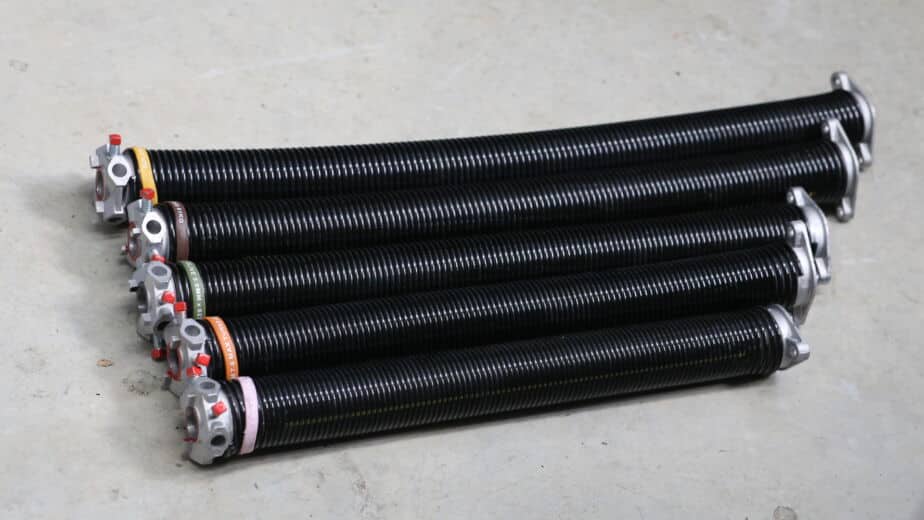
Many sectional garage doors use either a single-spring or dual-spring torsion arrangement.
Single-Spring System
A single-spring system uses one torsion spring mounted on the torsion shaft above the garage door.
It is commonly found on some smaller or lighter sectional garage doors.
Advantages include:
- Fewer components.
- Simpler spring arrangement.
- Potentially lower replacement costs.
However, the spring must be correctly specified to provide sufficient counterbalancing torque throughout the door’s travel.
Dual-Spring System
A dual-spring system uses two torsion springs mounted on the same shaft.
This arrangement is commonly used on standard double garage doors and many heavier sectional doors.
Advantages include:
- The required lifting torque can be shared between two springs.
- Greater flexibility when designing the spring system.
- Each spring can contribute to balancing the overall door weight.
However, having two springs does not automatically mean the system has twice the appropriate lifting capacity. Both springs must be correctly matched to the door and lifting hardware.
General Spring Arrangement Guide
| Door type | Typical arrangement | Important considerations |
|---|---|---|
| Small / lightweight sectional door | 1 spring | Depends on door weight and manufacturer design |
| Standard single garage door | 1 or 2 springs | Depends on spring system and required torque |
| Standard double garage door | Often 2 springs | Both springs must be correctly matched |
| Heavy sectional door | 2 or more springs | Requires accurate spring calculations |
| Large / custom sectional door | Varies | Individual engineering assessment required |
These are general examples only. The number of springs should never be determined by door width alone.
4. Understanding Combined Spring Capacity
When a garage door uses two springs, both springs contribute to the overall counterbalancing force.
For example, consider a simplified system where the required lifting capacity is represented as approximately 100 kg equivalent.
A theoretical arrangement might be:
- Spring 1: 50 kg equivalent
- Spring 2: 50 kg equivalent
- Combined equivalent: 100 kg
50 + 50 = 100 kg equivalent
This example helps explain how two springs can share the required load.
However, actual torsion spring selection is based on torque, not simply adding the advertised weight ratings together.
The spring torque must be appropriate for the cable drum radius and the changing geometry of the door as it travels.
Therefore, two springs labelled as 50 kg equivalent are not automatically suitable for every 100 kg garage door.
The correct combination must be verified against the complete lifting system.
5. What Determines the Correct Spring Size?
One of the most common mistakes in garage door spring replacement is assuming that the replacement spring can be selected simply by measuring the old spring.
In reality, several factors need to be considered.
A. Actual Door Weight
This is one of the most important factors.
A garage door’s weight depends on its overall construction, including the panels, insulation, reinforcement, windows and hardware.
Two sectional doors with identical external dimensions can have significantly different weights.
For example:
- A standard non-insulated sectional door.
- An insulated sectional door.
- A sectional door with additional steel reinforcement.
- A door fitted with decorative windows.
Each may require a different spring specification.
B. Door Width and Height
Door dimensions affect the lifting system and the amount of torque required.
A wider or taller garage door may require a different combination of springs and cable drums.
However, dimensions alone cannot determine the correct spring.
The actual weight and mechanical configuration must also be considered.
C. Spring Wire Diameter
Wire diameter is one of the most important spring specifications.
Even a small difference in wire diameter can significantly change the spring’s torque characteristics.
For this reason, measuring the wire diameter accurately is essential when identifying an existing spring.
D. Spring Inside Diameter
The inside diameter determines how the spring fits onto the torsion shaft.
Common spring inside diameters vary depending on the garage door system.
The replacement spring must be compatible with the shaft and the intended spring configuration.
E. Spring Length
Spring length is another important measurement.
However, a longer spring is not necessarily stronger than a shorter spring.
The lifting characteristics depend on the combination of wire diameter, inside diameter, active coils and other spring specifications.
F. Cable Drum Size
Cable drums play an important role in converting spring torque into lifting force.
Different cable drum sizes can change the relationship between spring torque and the force applied to the lifting cables.
A spring that works correctly with one cable drum may not provide the correct balance when used with another.
G. Expected Spring Cycle Life
Garage door springs are designed to operate for a certain number of opening and closing cycles.
A cycle generally means one complete opening and closing operation.
Common spring cycle ratings include:
- 10,000 cycles
- 15,000 cycles
- 20,000 cycles
- 25,000 cycles or more
Higher-cycle springs are often designed to provide longer service life under appropriate operating conditions.
However, a higher-cycle spring is not automatically a suitable replacement. It must still provide the correct torque and fit the existing lifting system.
6. Why Does a Garage Door Spring Break?
Garage door springs are under considerable mechanical tension and gradually wear out through repeated operation.
There are several common reasons why a spring may eventually break.
Normal wear and tear
Every time the garage door opens and closes, the spring experiences another operating cycle. Over time, the spring material becomes fatigued.
Incorrect spring specification
A spring that is incorrectly selected for the door may experience excessive stress or fail to balance the door properly.
Corrosion
Moisture and environmental conditions can contribute to corrosion, potentially reducing the spring’s service life.
High usage frequency
A garage door used several times every day will generally reach its rated cycle life sooner than one used occasionally.
Incorrect installation or adjustment
Improper installation, winding or adjustment can create dangerous operating conditions and increase the risk of premature failure.
7. What Happens When a Garage Door Spring Is Too Weak or Too Strong?
Correct spring selection is important for both performance and safety.
If the Spring Is Too Weak
A spring with insufficient counterbalancing torque may cause:
- The garage door to feel unusually heavy.
- The electric opener to struggle when lifting the door.
- The door to stop or reverse during operation.
- Increased strain on the opener motor and drive mechanism.
- Premature wear of other garage door components.
If the Spring Is Too Strong
A spring with excessive counterbalancing torque may cause:
- The garage door to rise too quickly.
- The door to become difficult to close.
- The door to remain open when it should be closed.
- Increased tension on lifting cables and hardware.
- Unstable door operation.
The goal is not simply to install a stronger spring. The goal is to achieve the correct balance throughout the full travel of the door.
8. How Can You Tell If Your Garage Door Is Properly Balanced?
A correctly balanced sectional garage door should operate smoothly without requiring excessive force.
Some warning signs of an incorrectly balanced door include:
- The door feels unusually heavy when operated manually.
- The door rises or falls unexpectedly.
- The door does not remain in its intended position.
- The electric opener struggles or makes unusual noises.
- The door moves unevenly or appears to tilt.
- The lifting cables appear loose or uneven.
If you notice any of these symptoms, stop operating the door if it appears unsafe and arrange for a professional inspection.
Safety warning: Torsion springs store a significant amount of mechanical energy. Never attempt to wind, unwind, adjust or remove a torsion spring yourself. Incorrect handling can cause serious injury.
9. Why Replacing a Garage Door Spring With the Same Size Is Not Always the Best Solution
In many cases, technicians can use the existing spring specifications as a starting point when replacing a broken spring.
However, simply copying the old spring dimensions is not always the best approach.
For example:
- The previous spring may have been incorrectly specified.
- The door may have been modified since the original installation.
- Additional insulation or windows may have increased the door weight.
- The cable drums may have been changed.
- The previous spring may have been selected for a different cycle-life requirement.
A professional assessment helps ensure that the replacement spring is suitable for the current door configuration.
In some situations, the technician may recommend a different spring specification to improve the balance and operating performance of the door.
10. Sectional Garage Door Spring Assessment – What Does Our Technician Check?
At Eden Garage Doors, selecting the correct replacement spring involves looking at the complete lifting system rather than just the broken spring.
Depending on the door configuration, our technician may inspect:
| Component | What we check |
|---|---|
| Door dimensions | Overall width and height |
| Door weight | Actual or calculated door weight |
| Door panels | Material, construction and insulation |
| Spring wire | Wire diameter |
| Spring diameter | Inside diameter |
| Spring length | Overall spring dimensions |
| Spring arrangement | Single or dual-spring configuration |
| Torsion shaft | Shaft size and condition |
| Cable drums | Drum type, size and compatibility |
| Lifting cables | Condition, routing and tension |
| Bearings and brackets | Wear, alignment and condition |
| Spring cycle rating | Expected service life |
This assessment allows us to identify an appropriate spring specification and check that the complete system operates safely.
11. Frequently Asked Questions About Sectional Garage Door Springs
Q1. How much weight can one garage door torsion spring lift?
There is no single answer because spring capacity depends on its wire diameter, inside diameter, length, winding and the cable drum configuration.
Some springs may be described using approximate weight-equivalent ratings, but these should not be treated as universal specifications.
Q2. Does a double garage door always need two springs?
No. Many double sectional doors use two springs, but the correct arrangement depends on the manufacturer’s design, door weight and lifting system.
Q3. Can I use two smaller springs instead of one large spring?
Some systems are designed to use two springs that share the required counterbalancing torque. However, the springs must be correctly calculated and matched to the door and hardware.
Q4. Can I replace a broken spring with one that has the same dimensions?
Not necessarily. The existing spring dimensions are useful for identification, but they do not guarantee that the original spring was correctly specified.
Door weight, cable drum size and the complete lifting arrangement should also be checked.
Q5. How long should a garage door spring last?
Spring life is generally measured in operating cycles rather than years.
For example, a 10,000-cycle spring used four times per day would theoretically reach its rated cycle count in approximately 6.8 years.
Actual service life depends on usage, installation, maintenance and operating conditions.
Q6. Should both springs be replaced if only one has broken?
On a dual-spring system, both springs have generally experienced a similar number of operating cycles.
If one breaks, the remaining spring may also be approaching the end of its service life.
Replacing both springs together is often recommended, particularly when both are of the same age and specification. However, the technician should assess the condition and compatibility of the complete system.
Q7. Is a stronger spring better?
No. A stronger spring is not necessarily better.
The spring must provide the correct counterbalancing torque for the door. Excessive spring force can cause the door to operate incorrectly and may place additional stress on other components.
12. Need Help Finding the Correct Garage Door Spring?
Choosing the correct sectional garage door spring is more complicated than simply matching its length or estimating the door weight.
The spring must be compatible with the door’s weight, dimensions, cable drums and lifting hardware.
At Eden Garage Doors, we can assess your existing sectional garage door system and help identify the appropriate replacement spring.
If your garage door has a broken spring, feels unusually heavy or is no longer operating smoothly, contact our team for professional assistance.
To help us understand your garage door, you can provide:
- A photo of the full garage door.
- A photo of the spring assembly above the door.
- The approximate width and height of the door.
- Any information about the existing spring specifications, if available.
Our technician can use this information as an initial reference before assessing the door and determining the correct spring requirements.
Eden Garage Doors – Professional Garage Door Spring Replacement and Repairs Across Auckland.
Visit: https://edengaragedoors.co.nz/
Contact Eden Garage Doors today to arrange an inspection or discuss your garage door spring replacement.