Torsion Springs – How They Work and Why Replacement Is Dangerous
Sectional garage doors use torsion springs to counterbalance the weight of the door.
The springs are normally mounted on a shaft above the garage door. When the door is closed, the springs store energy. As the door opens, that stored energy helps lift the door and reduces the amount of force required from the garage door opener.
Torsion springs are under significant stored tension, which is why spring replacement is one of the most dangerous jobs associated with garage door repairs.
This page is intended to give homeowners a basic understanding of sectional door torsion springs. It is not a DIY replacement guide.
How Much Weight Does a Torsion Spring Support?
The lifting capacity of a sectional door torsion spring can vary significantly depending on its specification.
As a general guide, a single spring may provide approximately 30–70 kg of lifting capacity, although the actual capacity depends on:
- Wire diameter
- Spring inside diameter
- Spring length
- Number of active coils
- Spring material
- Spring cycle rating
- Cable drum size
- Door weight and construction
- Door dimensions
- Spring configuration
A typical arrangement is:
- Single-size sectional door: usually one torsion spring
- Double-size sectional door: usually two torsion springs
However, this is only a general arrangement. Some doors may use a different number or configuration of springs depending on the door design, weight and manufacturer specifications.
Example
If a garage door weighs approximately 100 kg, a correctly selected spring system may provide approximately 100 kg of combined lifting capacity.
For example:
50 kg spring + 50 kg spring = approximately 100 kg total lifting capacity
This allows the springs to counterbalance the door weight, making the door relatively easy to lift manually and reducing the load placed on the garage door opener.
The actual spring selection should always be based on the measured door weight and complete door system, rather than simply assuming a particular spring size from the door dimensions.
What Does a Properly Balanced Door Feel Like?
A correctly balanced sectional door should be relatively easy to operate manually.
With the door fully closed, there may be some downward tendency when the door is first lifted. As the door moves through its travel, the balance should change appropriately.
When the door is positioned around the middle of its travel, a correctly balanced system will generally allow the door to remain reasonably stable rather than rapidly falling or rising by itself.
A door that:
- Drops heavily
- Shoots upward
- Is extremely difficult to lift
- Will not remain reasonably stable at mid-travel
- Feels significantly different from one side to the other
may have a spring balance problem or another mechanical issue.
A garage door that is difficult to lift is not necessarily a problem with the motor. The springs, cables, rollers, tracks, hinges and door weight all affect the amount of force required to operate the door.
How Do We Choose the Correct Torsion Spring?
There is no single spring that fits every sectional garage door.
An experienced garage door technician can often identify the likely spring specification from the door’s construction and existing hardware. However, the existing spring should not automatically be copied without checking the complete system.
This is important because incorrect springs can sometimes have been installed on older doors.
The correct spring selection may require consideration of:
- Door width and height
- Door weight
- Door material and panel construction
- Number and type of panels
- Window configuration
- Insulation
- Cable drum size
- Existing spring configuration
- Spring dimensions
- Required lifting capacity
- Expected cycle life
Where possible, Eden Garage Doors can inspect the existing spring and door system and select a spring that is appropriate for the actual door.
Do not rely on spring colour alone
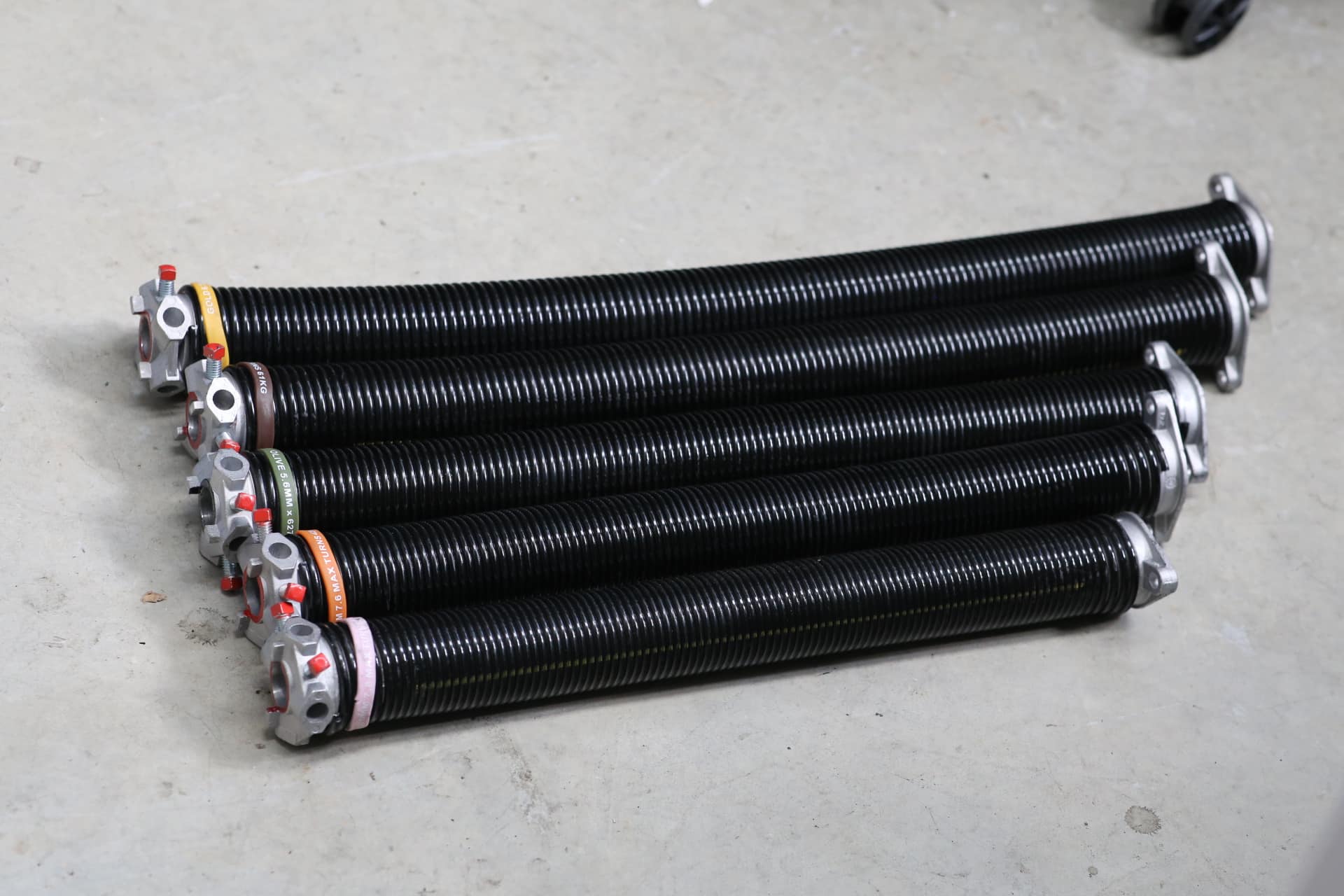
Some manufacturers use colour coding to identify different spring capacities or specifications. However, colour codes are manufacturer-specific and should not be treated as a universal garage door spring standard.
For this reason, a spring should be identified by its complete specification and the door it is designed to operate, rather than by colour alone.
Windsor Door Torsion Springs
There are many different torsion spring systems used on sectional garage doors in New Zealand.
For Windsor Doors, spring colours are commonly used to identify different spring capacities.
As a general guide, the commonly encountered colours include:
Pink → Orange → Olive → Brown → Gold
with the capacity increasing through the range.
There are also longer spring options used for taller doors, including colours such as:
Yellow → Silver → Alpine Blue
The exact spring specification still depends on the door and spring configuration.
Left and Right-Hand Springs
On some Windsor sectional door systems, the springs are colour-coded according to their winding direction.
When looking at the door from inside the garage facing the door, the commonly used arrangement is:
- Left-hand spring – Red
- Right-hand spring – Black
However, colour and winding-direction identification can vary between door systems and should always be confirmed before any spring is removed or replaced.
Why Is Torsion Spring Replacement So Dangerous?
The main danger is stored mechanical energy.
A torsion spring is deliberately wound under tension. When the door operates, this stored energy is transferred through the torsion shaft, cable drums and lifting cables to help raise the door.
If a person incorrectly handles the spring, winding components, shaft, cable drum or related hardware, the stored energy can be released suddenly.
This can result in:
- Serious hand or finger injuries
- Broken bones
- Cuts and impact injuries
- Damage to the door or surrounding property
- A sudden movement of the garage door
- Loss of control of the door
The risk is particularly high when attempting to remove or adjust a spring that is still under tension.
Torsion spring replacement should therefore be carried out by an experienced garage door technician using the correct tools and procedures.
What Happens When a Torsion Spring Breaks?
One of the most noticeable signs of a broken torsion spring is that the garage door suddenly becomes much heavier.
For example, if a door normally has two springs and one spring breaks, the remaining spring may only be capable of supporting approximately half of the door’s required counterbalance.
The result can be:
- The door becomes extremely heavy
- The opener struggles to lift the door
- The door may only rise a short distance before stopping
- The door may move approximately 10–20 cm and then stop, depending on the opener and door
- The door cannot be safely lifted manually
- The spring may show a visible gap where it has broken
- A loud “bang” may have been heard when the spring failed
The exact symptoms vary depending on the opener, door weight, spring configuration and condition of the rest of the door system.
Why You Should Not Keep Operating the Door
When a torsion spring breaks, the garage door opener is no longer operating under its normal load conditions.
Continuing to operate the door can place excessive load on:
- Garage door opener
- Drive gears and motor
- Torsion shaft
- Lifting cables
- Cable drums
- Rollers and tracks
- Door panels and hinges
More importantly, the door may be significantly heavier and less stable than normal.
Do not repeatedly press the opener to try to force the door open.
Do not attempt to manually lift a heavy sectional door without proper support.
If you suspect a broken torsion spring, stop operating the door and contact a professional garage door technician.
Eden Garage Doors – Torsion Spring Replacement
When Eden Garage Doors attends a sectional door with a suspected broken spring, we do more than simply replace the broken spring.
We inspect the complete door system, including:
- Torsion springs
- Torsion shaft
- Cable drums
- Lifting cables
- Rollers
- Tracks
- Hinges
- Bearing plates
- Door balance
- Garage door opener
- Door panels and mounting hardware
We then determine the appropriate spring specification for the actual door and adjust the system so that the door is correctly balanced.
Where a door uses matching springs, we generally recommend replacing both springs together when one has failed. Both springs normally have experienced a similar number of operating cycles, so replacing only one can leave the other near the end of its service life.
Broken Torsion Spring?
If your sectional garage door suddenly becomes very heavy, the opener only lifts the door a short distance, or you can see a gap in the torsion spring:
Do not force the door open.
Do not attempt to adjust or remove the spring yourself.
Contact Eden Garage Doors for an inspection and professional torsion spring replacement.
The correct spring is not simply the same length as the old spring. It must be correctly matched to the door, hardware and required lifting capacity.